Best Supplement For Memory12 Best Brain Supplements for Adults: How to Compare Them
12 Best Brain Supplements for Adults: How to Compare Them
The short answer
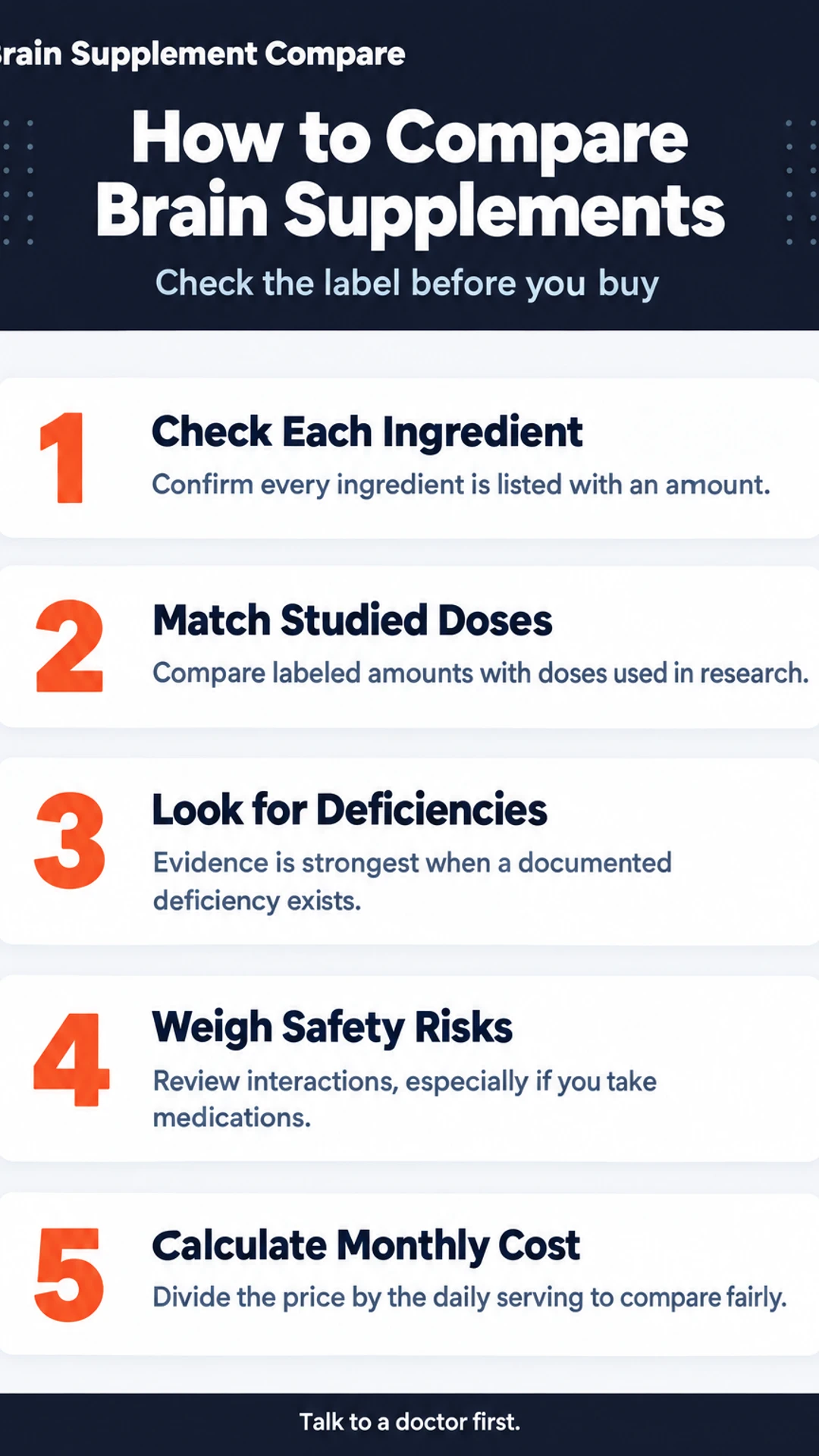
The best brain supplement for an adult is the one whose ingredients, disclosed doses and cost hold up when compared side by side. Check whether each ingredient is listed with an amount, whether that amount matches doses studied in research, and what the product costs per month at that dose. Evidence is strongest for correcting a documented deficiency, such as low B12, and weaker for general 'brain support' claims. Talk to a doctor first if you take medications.
Some links on this site are affiliate links: if you buy through one, the site may earn a commission at no extra cost to you. More about this.
Based on the product's documentation and what users report, not our own testing. Last checked: 14 November 2026.
This guide covers 12 brain supplements for adults, compared on the things that actually separate them: labeled ingredient amounts, dosing, safety considerations and monthly cost. Items were chosen for how often adults look them up and for how much their labels can be checked against published research. For a quick overview, the table below sums up what to check for each one.
| # | Option | What to check on the label | Evidence strength |
|---|---|---|---|
| 1 | Omega-3 fish oil (EPA and DHA) | Milligrams of EPA and DHA per serving | Moderate, mostly for people with low intake |
| 2 | Vitamin B12 | Whether a deficiency has been measured | Strongest where a deficiency exists |
| 3 | B-complex (B6, B9, B12) | Milligrams of B6 and folate per tablet | Limited as a bundle |
| 4 | Magnesium | Elemental magnesium per serving | Plausible but modest |
| 5 | Choline | Elemental choline per serving | Mostly from food intake studies |
| 6 | Creatine monohydrate | Grams per serving and form | Stronger for muscle, smaller for cognition |
| 7 | Ashwagandha | Root or leaf extract, standardisation | Mainly for stress, mixed for cognition |
| 8 | Ginkgo biloba | Standardised extract | Inconsistent in healthy adults |
| 9 | Phytomem One | Amount of each ingredient | Not disclosed by the vendor |
| 10 | Vitamin D3 | Daily IU, and a blood test result | Relevant mainly where deficient |
| 11 | Phosphatidylserine | Source and dose per capsule | Older, well-studied option |
| 12 | Lion's mane mushroom | Extract type and beta-glucan amount | Small, short human studies |
Omega-3 Fish Oil (EPA and DHA): DHA is the omega-3 most concentrated in brain tissue, so it is the number to check on the label. Triglyceride form and third-party testing for oxidation are worth comparing.
Vitamin B12: The evidence for cognitive benefit is strongest where a deficiency already exists, which becomes more common with age and with long-term metformin or acid-reducer use, since both can lower B12 absorption. Check whether a serum B12 or methylmalonic acid level has been measured before buying. Cyanocobalamin and methylcobalamin are both used in supplements, and the form matters less than correcting a documented shortfall.
B-Complex (B6, B9 as folate, B12): A bundled product only makes sense if each dose is appropriate for an adult, which is not always the case. Many B-complex tablets include B6 well above the 100 mg daily upper limit used in most safety reviews, and folate as folic acid can mask a B12 deficiency. Compare the milligram amounts per tablet against the daily values, and consider whether you need all three or only one.
Magnesium: Magnesium is often sold for sleep and calm, and the link to cognition is plausible but modest, so set expectations accordingly. Magnesium glycinate and magnesium citrate are better absorbed and gentler on the gut than magnesium oxide, which is cheap but poorly absorbed. Compare the elemental magnesium per serving.
Choline: Many adults under-consume choline, and the evidence on cognition comes mostly from food intake and early-life research rather than from supplement trials in older adults. Eggs and beef liver are the richest common sources. Supplemental forms such as choline bitartrate and CDP-choline differ in choline content per gram, so compare the elemental choline per serving before assuming a higher dose is better.
Creatine Monohydrate: Creatine monohydrate is well studied for muscle, while the cognition evidence is smaller and newer, mainly for specific conditions and for sleep deprivation. Plain monohydrate is the form with the most research behind it, so extra-cost forms claiming better brain uptake have not been shown to outperform it.
Ashwagandha: Mostly used for stress, which is where its evidence is strongest. Cognitive results are mixed: some small trials report better attention or recall under stress, while others show little difference. Liver injury has been reported in some products, so check the label for root versus leaf extract and for standardisation, and talk to a doctor if you have liver disease or take other medicines.
Ginkgo Biloba: A long-established herbal extract with a lot of trial data behind it. Results on memory in healthy adults have been inconsistent, with some trials showing no benefit over placebo. Ginkgo can increase bleeding risk, especially alongside aspirin, warfarin or other anticoagulants, so review interactions before starting. Look for standardised extracts rather than raw leaf powder.
Phytomem One: A 10-ingredient single-tablet product sold only through its own sales page, so the label and terms carry more weight than usual. This assessment is based on the product's documentation and what users report, not our own testing. The vendor says the formula includes saffron extract, fucoxanthin, berberine HCl and Ceylon cinnamon, but it does not disclose the amount of each ingredient, which makes dose comparison difficult. It is sold on a 60-day money-back guarantee, and one reviewer found results depend heavily on sleep, nutrition and consistency.
Vitamin D3: Relevant to cognition mainly where a deficiency is present, and the evidence for general brain benefit in people with adequate levels is limited.
Phosphatidylserine: An older, well-studied option with a regulatory history that affects how products are labelled. Earlier formulations were derived from bovine brain, which led to restrictions, and many current products use soy- or sunflower-derived versions. Typical studied doses are around 100 mg three times daily. Check whether the label names the source and the dose per capsule, since those details vary between brands.
Lion's Mane Mushroom: Widely marketed for cognition, but human research is small and short, so claims should be treated cautiously. Most studies use fruiting body extract rather than mycelium-grown products, and the two are not interchangeable. When comparing labels, look for the extract type and the amount of beta-glucan, not just the gram weight of mushroom powder.
Frequently asked questions
What does Mayo Clinic say about brain supplements?
Mayo Clinic's general position is that most people do not need supplements for brain health, and that a varied diet covers most nutritional needs. It advises talking with a doctor before starting one, especially if you take medications, have a chronic condition, or are considering high doses. Check the clinic's own site for its current wording.
Is Prevagen or Neuriva better?
Neither can be called better in general, because they are built on different ingredients and have different evidence behind them. Compare the actual ingredient list and amounts per serving, check whether the claims are supported by studies on those specific ingredients, and look at cost per month. Prevagen and Neuriva are not the focus of this article, so verify current details on each product's label.
Research on B vitamins, vitamin D and omega-3s has produced mixed results, and benefits seen in some trials have not held up in others. Any specific percentage claim needs a named, peer-reviewed study behind it before you rely on it.
Do any of those brain supplements really work?
Some ingredients have modest evidence in specific groups, such as omega-3s or vitamin B12 for people who are deficient, but the evidence for most branded formulas is thin. Many products are tested mainly in small or company-funded studies. Expect gradual, uncertain effects at best, and treat user reports as anecdotes rather than proof.
How should I compare brain supplements before buying?
Start with the ingredient list and check whether each ingredient is disclosed with an amount. Then look for human studies on those amounts, not just on the ingredient in a lab or animal model. Finally compare cost per daily serving, return policy and any safety warnings, and check with your doctor if you take other medications.
Wrapping up
Those are the 12 options covered here, and the comparison comes down to ingredients, dosing and cost rather than sales copy.
Which of the 12 will you try first, or did I miss one you already use?
If you want to look more closely at Phytomem One's offer, you can visit the official site to see its plans, its 60-day money back guarantee and its ingredient groups as the vendor describes them.