Best Supplement For Memory12 Questions to Ask Before Buying a Memory Supplement for Seniors
12 Questions to Ask Before Buying a Memory Supplement for Seniors
The short answer
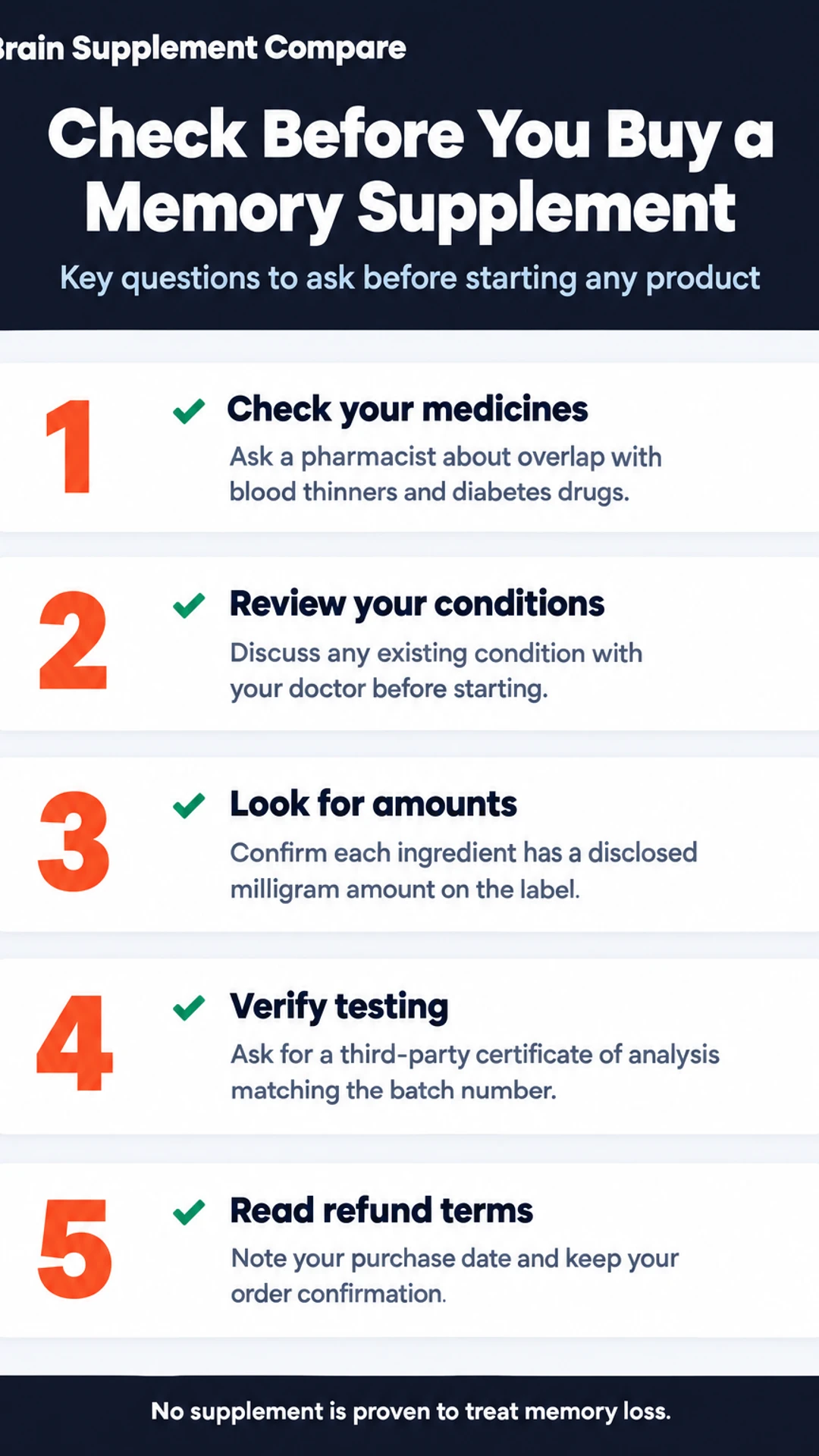
The best memory supplement for seniors depends on the person, so start with questions rather than a brand. Check whether the product interacts with current medicines, especially blood thinners and diabetes drugs, and whether it suits any existing condition. Then confirm that ingredient amounts are disclosed, read the dose correctly, and check the refund terms. No supplement is proven to treat memory loss.
Some links on this site are affiliate links: if you buy through one, the site may earn a commission at no extra cost to you. More about this.
Based on the product's documentation and what users report, not our own testing. Last checked: 14 November 2026.
This list gives you 12 questions to ask before you buy a memory supplement for seniors. The questions were chosen to separate what a product's documentation actually states from what marketing implies, and to flag the points where older adults most often run into trouble: medication overlap, existing conditions, label gaps and refund fine print.
Based on the product's documentation and what users report, not our own testing, we also look at one product in this set, Phytomem One, as a worked example. Its sales page says it contains 10 ingredients and is sold only on its own website, and the terms say the site is for adults 18 and older. Those details matter, so we check them against each question.
Let's dive in.
Which of my current medicines could interact with this?: Medication overlap is the first safety check for older readers, and it matters more when a product mixes many active ingredients. Several herbal and plant extracts in brain supplements can affect how blood thinners, blood sugar drugs and blood pressure medicines work. Ginkgo biloba is the usual example people raise, because it can add to the effect of anticoagulants. Bring the full product label to your pharmacist and ask them to check each active ingredient against your list, not just the product name.
Do I have a condition that changes the risk?: Existing conditions can make an ingredient unsuitable even when the product seems well made. Berberine and banaba-type extracts can lower blood sugar, which needs care if you have diabetes or take glucose-lowering drugs. Anything with a stimulant effect deserves caution with heart rhythm problems or high blood pressure. Clinicians also flag bleeding risk before surgery. Go through your diagnoses with your doctor before you start, and keep notes of the outcome.
Are the ingredient amounts disclosed?: Without amounts you cannot judge whether a product contains a meaningful dose of anything, or compare it with another product. The ingredient list tells you what is in the bottle, not how much. Check whether each active ingredient has a milligram figure beside it. For Phytomem One, the fact sheet records that one independent reviewer found the ingredient amounts are not disclosed, so you would need to ask the seller directly before buying.
What does the recommended dose actually mean?: A dosing line such as "one capsule daily" describes the product's directions, not a dose shown to work for memory. Read the label for the number of units, the serving size and whether the amount is per capsule or per day. With several ingredients, one tablet can contain a little of each rather than an effective amount of any single one. For Phytomem One, the FAQ says the usual dose is one capsule daily with food, which is a directions statement rather than evidence of effect.
Does the product have a proprietary blend?: A proprietary blend lists ingredients together under one total weight, so you cannot see how much of each active compound you are getting. That makes it hard to know whether the ingredient linked to memory research is present in a useful amount. Look for the words "proprietary blend" or a single combined weight for several ingredients. Phytomem One's documentation groups its ten ingredients by function and does not give a per-ingredient breakdown in the material reviewed.
Has the product been independently tested?: Independent testing checks that the label matches what is inside and that the product is free of contaminants. Ask for a third-party certificate of analysis from a named lab, and check the batch number on the bottle against it. Phytomem One's sales page says its ingredients are handled under the USDA National Organic Program in a certified facility, which is a handling claim rather than a batch test. The review material did not identify an independent lab test of contents, so ask the seller for one.
Where is the product sold, and is it genuine?: Phytomem One is sold only on its own sales page, according to the vendor, and checkout runs through ClickBank. One reviewer found that imitation products are sold online, so buy only from the official site, not from third-party listings or resellers offering lower prices. Check the seller before entering any card details.
What are the refund terms and how do I claim them?: The sales page describes a 60-day money back guarantee with a full refund if you are not satisfied. To claim it, you email the team, according to the page. Note the date you bought, keep your order confirmation, and check the terms before relying on this, since the page's wording is the vendor's own and not independently verified.
How long should I give it before judging?: The vendor describes the formula as built for lasting mental clarity and recall, and a 60-day trial window is offered. Several reviewers say results need consistent daily use over weeks, and one independent source notes that results depend on sleep, activity, stress and nutrition too. Judge over the full trial period, not after a few days.
Is the product suitable for someone my age and health status?: The website terms limit use to adults aged 18 and over, but that is a site-use rule, not a statement that the product suits older adults with particular conditions. The sales page advises checking with a doctor if you have safety concerns. Ingredient amounts are not disclosed, so you cannot easily judge dose against your own health situation.
What should I ask my doctor or pharmacist?: Bring the full ingredient list: saffron extract, fucoxanthin, fucoidan, oleuropein, berberine HCl, Ceylon cinnamon, corosolic acid from banaba leaf, kudzu flower extract, Morosil and xylitol. Ask about overlap with any blood sugar, blood pressure or blood-thinning medicines, and whether the usual one capsule daily with food is appropriate for you.
Could a memory problem have another cause?: Memory changes can come from thyroid problems, vitamin B12 deficiency, medication side effects, sleep disorders, depression or other treatable conditions. A supplement should not delay a proper check. Ask your doctor for a review before, or alongside, any trial, and do not treat a supplement as a substitute for assessment.
Frequently asked questions
What is the best vitamin for seniors for memory?
No single vitamin has been shown to be the best for memory in older adults. Vitamin B12 matters most when a deficiency is present, since low levels are linked to cognitive symptoms, and a blood test is the only way to confirm one. Vitamin D, folate and omega-3s are studied too, but results are mixed. Check your levels and your medications before choosing anything.
What do Japanese eat to prevent dementia?
Traditional Japanese diets are built on fish, soy, green tea, seaweed, rice, vegetables and modest portions. Researchers link this pattern with lower dementia rates in some population studies, but diet is only one factor alongside genetics, activity and social life. The link is an association, not proof that any single food prevents dementia. Eating a varied, fish-forward diet is a reasonable goal regardless.
Does Prevagen or Neuriva actually work?
The published evidence for both is limited. Prevagen's main ingredient, apoaequorin, has been the subject of a regulatory challenge over its memory claims, and the FTC and New York attorney general brought action against its maker. Neuriva's trials have been small and mostly funded by its manufacturer. Neither is a substitute for a medical evaluation of memory complaints.
What does Mayo Clinic recommend for memory?
Mayo Clinic's guidance on memory focuses on habits: regular physical activity, sleep, managing blood pressure, blood sugar and hearing loss, staying socially engaged, and avoiding heavy alcohol use. It also advises talking to a doctor about memory changes, since some causes such as thyroid problems, medication side effects and vitamin deficiencies are treatable. Supplements are not presented as a core recommendation.
What should a senior ask a doctor before taking a memory supplement?
Ask whether any ingredient interacts with your current medicines, especially blood thinners, diabetes drugs, blood pressure medicines and sedatives. Ask whether your memory complaint has a treatable cause and whether a blood test is needed first. Bring the full ingredient label, including doses, so the doctor can check it against your prescriptions.
Wrapping up
That makes 12 questions to ask before buying a memory supplement for seniors, covering ingredients, medication overlap, existing conditions and dosing.
Which one will you check first, and is there a question you think we missed?
If you want to look at the product named in this review, you can Visit the official site to read its ingredient list, plan options and 60-day refund terms before deciding.