Best Supplement For Memory12 Brain Supplement Ingredients for Memory and Focus, Mapped by Claim
12 Brain Supplement Ingredients for Memory and Focus, Mapped by Claim
The short answer
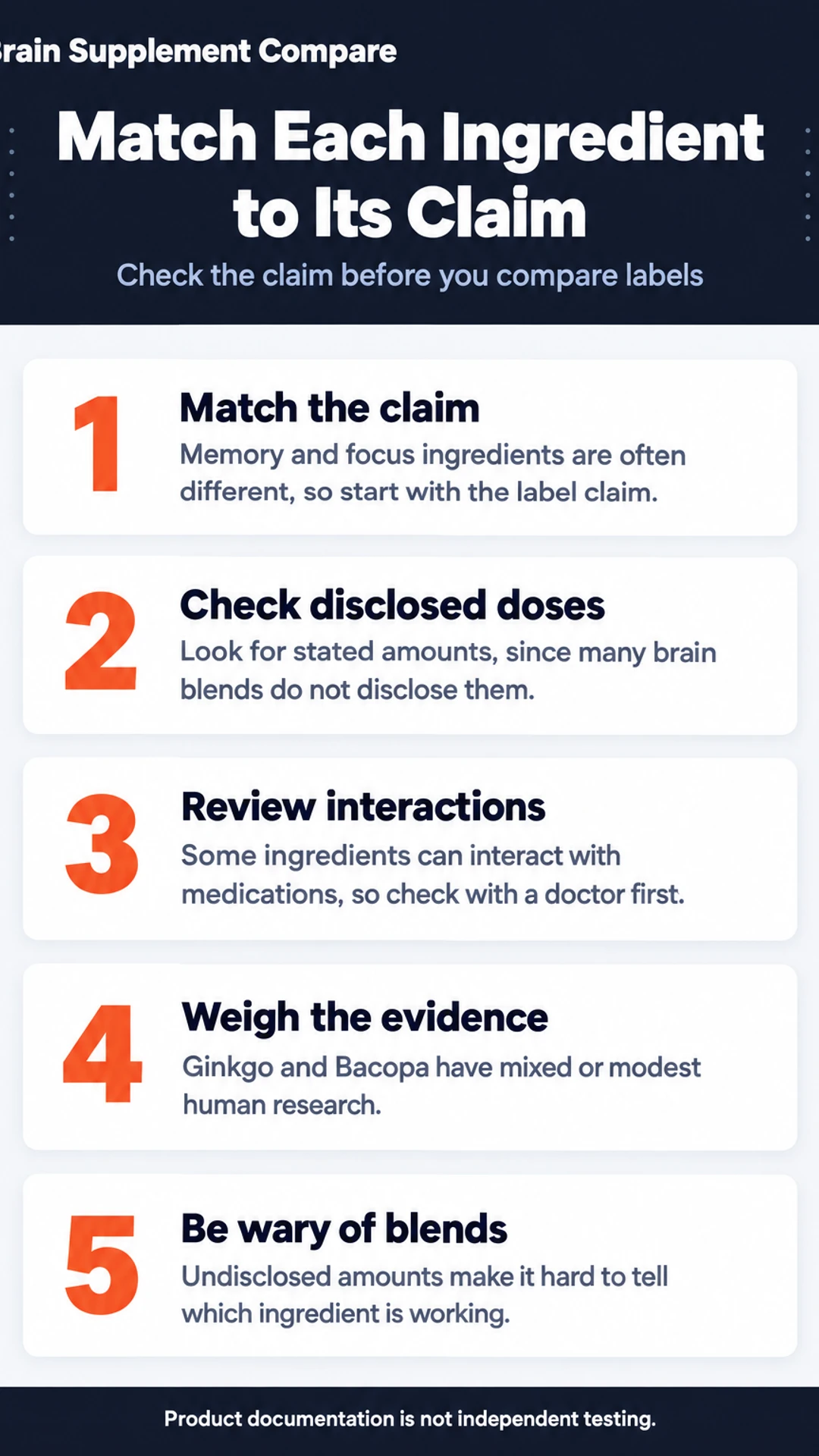
The best brain supplement for memory and focus depends on which claim you are checking. Ingredients marketed for memory are often different from those marketed for focus, and many products combine both. Before comparing options, match each ingredient to the claim on the label, check whether doses are disclosed, and review known interactions with any medications you take. Product documentation is not independent testing.
Some links on this site are affiliate links: if you buy through one, the site may earn a commission at no extra cost to you. More about this.
Based on the product's documentation and what users report, not our own testing. Last checked: 14 November 2026.
This page maps the ingredients in a set of brain supplements to the claims they are usually sold under, so you can see which claim a given product actually supports before you weigh its label against the others. Based on the product's documentation and what users report, not our own testing, we have included one product in detail here: Phytomem One, sold only through its official website.
12 brain supplement ingredients are grouped below by the claim each is most often marketed for, memory or focus, with notes on where the label stops telling you enough. Items were chosen because they appear repeatedly in supplements sold for cognitive support and have a body of published research, or a clear lack of it, that you can check yourself.
Let's dive in.
Brain supplements at a glance
| Option | Main claim | Key limitation |
|---|---|---|
| Ginkgo Biloba | Memory | Mixed research results |
| Bacopa Monnieri | Memory | Modest, slow-acting effects |
| Creatine | Focus under mental fatigue | Studied mainly in sleep deprivation |
| B Vitamins (B6, B12, Folate) | Deficiency correction | No benefit shown without deficiency |
| Berberine HCl | Multi-claim, brain blends | Limited brain evidence, drug interactions |
| Ceylon Cinnamon and Banaba Leaf | Purpose not stated | No memory result found |
| Saffron Extract | Mood and memory | Dose cannot be compared to trials |
| Fucoxanthin and Fucoidan | Cellular defense | Mostly cell and animal evidence |
A closer look at each
Ginkgo Biloba: Among the oldest memory ingredients on the market, usually sold as a standardized leaf extract. Its research base is mixed. Some trials in older adults with mild cognitive complaints show small effects, while others show none. It is worth checking whether a label names the extract standard, since amounts vary widely between products.
Bacopa Monnieri: Frequently listed beside memory claims in ranking pages, usually as a standardized extract with a stated bacoside content. Human studies on recall have been modest and often short, and effects tend to take several weeks to appear. A label that gives the bacoside amount tells you more than one that only says "bacopa."
Creatine: Shows up in brain supplement lists because it plays a role in cellular energy supply. It is usually claimed to help focus under mental fatigue rather than memory directly. Most research on it comes from sleep deprivation and demanding mental tasks, not healthy adults at rest. Typical dosing is about 3 to 5 grams daily.
B Vitamins (B6, B12, Folate): Sold as brain support, but the case rests mainly on deficiency. In people who are low in B12 or folate, correcting the shortfall is the relevant step, and a blood test can show whether that applies to you. Taking them without a deficiency has not been shown to sharpen memory in healthy adults.
Berberine HCl: A multi-claim ingredient, best known in metabolic research, that appears in proprietary brain blends such as Phytomem One. Its listing there is the vendor's choice; the sales page groups it under "brain fuel." Brain-related evidence for berberine is limited, and it can interact with some medications, so check with a doctor first.
Ceylon Cinnamon and Corosolic Acid (Banaba Leaf): Both appear in Phytomem One's ingredient list. The sales page does not state a purpose for each one, so readers should ask what the vendor intends them to do. Corosolic acid from banaba is studied mainly for blood sugar, and cinnamon likewise. No memory result for either was found in the material reviewed.
Saffron Extract: Saffron (Crocus sativus) is marketed for mood and memory in several supplements, and it has been studied in small trials on mood and mild cognitive symptoms. Phytomem One lists saffron extract in its cellular defense group. The fact sheet does not give the dose used, so the amount per tablet cannot be compared with those trials.
Fucoxanthin and Fucoidan: These are seaweed-derived compounds, fucoxanthin a carotenoid and fucoidan a sulfated polysaccharide, that appear in cellular-defense claims. Phytomem One lists both in its cellular defense group. Most of the evidence for them comes from cell and animal work, so a memory claim built on them is indirect. Ask what amount is included.
Oleuropein: Oleuropein is a polyphenol from olive leaves and unripe olives, and it carries cellular-defense marketing. Phytomem One includes it alongside saffron, fucoxanthin and fucoidan. Human data on oleuropein and memory is thin, so treat its role in a formula as a general antioxidant claim rather than a proven memory effect.
Morosil and Kudzu Flower Extract: Morosil, a Sicilian red orange extract, and kudzu flower extract are less familiar ingredients that show up in multi-ingredient brain formulas. Phytomem One includes both, with kudzu in its brain fuel group and Morosil in its neural amplifier group. Their presence tells you little about memory or focus unless the amounts are disclosed, and Phytomem One's amounts are not disclosed.
Nootropic Stacks Such as Mind Lab Pro and Qualia Mind: These are multi-ingredient products that bundle memory and focus ingredients together. The advantage is that one bottle covers several mechanisms. The drawback is that a stack makes it hard to tell which ingredient is doing anything, and it makes dose comparison harder. Check each ingredient's amount against the research for that compound rather than trusting the bundle name.
Phytomem One: This is the product the hub page is built around. According to the sales page, it is a 10-in-1 formula with ingredients in three groups: cellular defense (saffron extract, fucoxanthin, fucoidan, oleuropein), brain fuel (berberine HCl, Ceylon cinnamon, corosolic acid from banaba leaf, kudzu flower extract) and neural amplifier (Morosil and xylitol). Ingredient amounts are not disclosed, and one reviewer found that imitation products are sold online, so buy only from the official site.
Frequently asked questions
Does Prevagen or Neuriva actually work?
Both have been studied, but the evidence is thin and mixed. The FTC took action over Prevagen's memory claims and questioned the supporting data. Neuriva has a few small trials, mostly funded by its maker. Neither has strong independent proof of improved memory in healthy adults, so check the specific ingredient studies rather than the brand claims.
What does Mayo Clinic recommend for memory?
Mayo Clinic does not recommend memory supplements as a treatment. Its guidance focuses on regular physical activity, good sleep, managing blood pressure, diabetes and hearing loss, staying socially and mentally active, and eating a diet such as the Mediterranean or MIND pattern. It notes that most supplements have not been shown to prevent memory loss.
Can a vitamin cut dementia risk?
No vitamin has been shown in reliable research to cut dementia risk by a specific amount, and the Phytomem One fact sheet makes no such claim. Claims like this usually trace back to small observational studies or misread results. Vitamin D, B vitamins and omega-3s have been studied, with inconsistent findings. Treat any single-vitamin percentage claim as unverified until you see the original study.
What does Joe Rogan take for memory?
Joe Rogan has discussed supplements on his podcast and in interviews, but there is no reliable public record of a complete, current memory stack that he takes daily. Lists circulating online are often unverified. Even if a supplement is mentioned, his use does not show it works for memory, so evaluate the ingredients on their own evidence.
How do I tell which brain supplement claim is backed by evidence?
Look at the ingredient and dose, then find studies on that exact ingredient at that dose in people similar to you. Blends with undisclosed amounts make this hard to judge. Be skeptical of claims about "cellular defense" or "neuro-support" that are not tied to measurable outcomes like recall tests or cognitive scores in controlled trials.
Wrapping up
We have covered 12 brain supplement ingredients for memory and focus, mapped by the claims they support.
Some ingredients have modest human research behind them, while many others rest on animal or lab work.
Which of these 12 will you try first, and which one did we miss?
If you are looking at Phytomem One, you can visit the official site to read the vendor's full ingredient list and plan options before deciding.