Best Supplement For Memory12 Natural Memory Supplement Label Terms and What They Really Mean
12 Natural Memory Supplement Label Terms and What They Really Mean
The short answer
Labels such as natural, non-GMO, stimulant-free and organic describe how ingredients were sourced or processed. They do not show that a product improves memory, and they do not show it is safe for you. Memory supplements are not reviewed for effectiveness before sale in the way prescription drugs are. Check the ingredient amounts, any third-party testing, and whether a doctor should review it if you take medications.
Some links on this site are affiliate links: if you buy through one, the site may earn a commission at no extra cost to you. More about this.
Based on the product's documentation and what users report, not our own testing. Last checked: 14 November 2026.
This article breaks down 12 natural memory supplement label terms and what each one does and does not tell you. These terms were chosen because they appear most often on brain health supplement packaging and sales pages, and because buyers tend to read them as evidence of benefit. Many of them are also a reason people search for a supplement's real ingredients before they buy.
Based on the product's documentation and what users report, not our own testing, we also look at how these terms apply to Phytomem One, a tablet sold only through its official website. Where the vendor makes claims, we attribute them to the vendor. Where a claim is backed only by user reports or by a single reviewer, we say so.
Let's dive in.
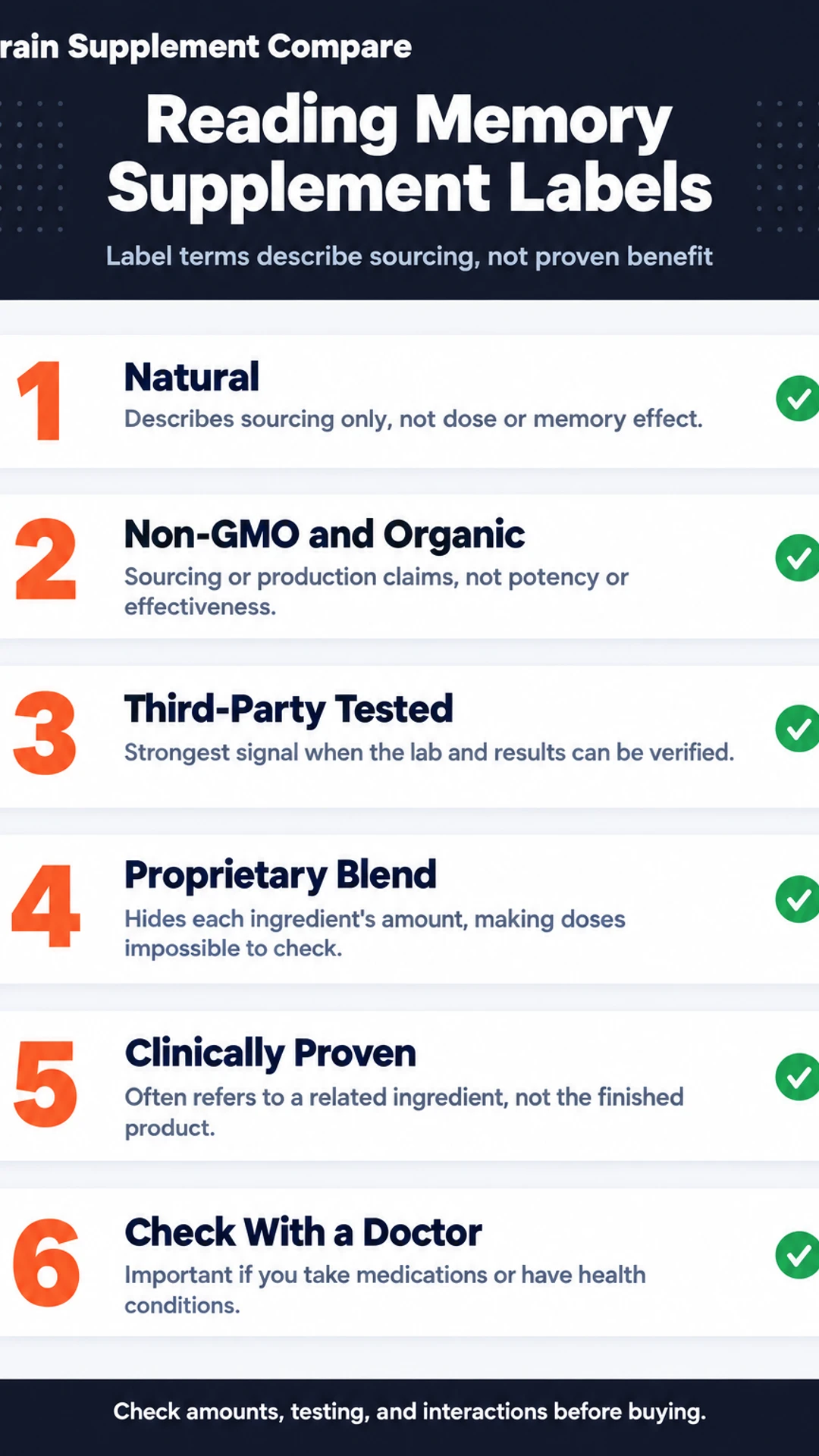
Memory supplement label terms at a glance
| Option | What the label term claims | What it does not show | Key check |
|---|---|---|---|
| Natural | Ingredients are plant, mineral or food-derived | Dose, purity or memory effect | Botanical name and extract ratio |
| Non-GMO | Crops not made with GM organisms | Potency, purity or efficacy | Treat as sourcing claim only |
| Stimulant-free | No added caffeine or similar stimulants | Formula is inert | Check botanical caffeine sources |
| USDA Organic | Production standard for crops | Potency or ingredient effectiveness | Ingredient or finished product certified |
| Certified facility or GMP | Manufacturing quality system followed | Product test or batch potency | Look for batch testing results |
| Third-party tested | Independent testing of identity or potency | Results unless lab is named | Lot number or verifiable certificate |
| Proprietary blend | Ingredients listed as one combined weight | Amount of each ingredient | Ingredient amounts not disclosed |
| Clinically proven | Trial run on related ingredient | Trial on finished product | Which study, dose and population |
A closer look at each
Natural: This is the least defined term on a memory supplement label, and no single regulator sets a standard for it that would tell you anything about efficacy. In practice it usually means the ingredients are plant, mineral or food-derived rather than synthetic. It says nothing about dose, purity, or whether a given extract has been shown to affect memory. Ask instead for the botanical name, the extract ratio, and the amount per capsule. Ginkgo biloba extract, for example, is typically standardised to specific flavonoid and terpene-lactone content, and that figure is the one worth checking on a ginkgo biloba product.
Non-GMO: Readers often take this to mean the product is safer or works better. It means only that the crops used as ingredients were not produced with genetically modified organisms, or that the supplier has been verified against a non-GMO standard. A non-GMO label is silent on potency, purity, contaminants and clinical support. A product can be non-GMO and contain an underdosed extract, so treat the label as a sourcing claim and nothing more.
Stimulant-free: This matters if you are sensitive to caffeine, take blood pressure medication, or notice heart rate and sleep changes. The claim means no added caffeine, guarana, synephrine or similar compounds. It does not mean the formula is inert. Some herbal ingredients have their own cardiovascular or sleep effects. Check the full ingredient list against your medications, and look for botanical sources of caffeine hidden under names such as green tea extract or guarana seed.
USDA Organic: Organic is often read as a quality guarantee, but it is a production standard. The fact sheet says all ingredients are handled according to the USDA National Organic Program in a certified facility. It does not name the certifying body, so the certification itself is not independently confirmed here. It does not test for potency, does not confirm that an ingredient is effective, and does not verify that the amount on the label is what is in the capsule. Organic certification of a supplement ingredient and organic certification of the finished product are also different things, so check which one a label claims.
Certified facility or GMP: This is a common reassurance that is often misunderstood. GMP stands for Good Manufacturing Practice. A facility that says it follows GMP is claiming that its processes meet a manufacturing quality system, covering cleanliness, batch records and equipment control. It is not a product test. Many facilities hold such certifications while their finished products still vary in potency from batch to batch. Treat it as a sign of process discipline, and look for batch-level testing results before relying on it.
Third-party tested: This is the strongest signal on a supplement label, but only when the testing body and the test are named and checkable. Look for a specific organisation, such as an independent lab or certification programme, and a way to verify it: a batch or lot number you can look up, or a certificate you can confirm on the certifier's own site. Vague claims such as a product being "tested" carry little weight unless a named lab or test results back them up. The product's pages do not name one, and one reviewer found that ingredient amounts are not disclosed. Independent verification of identity, potency and contaminant levels is what a buyer should ask for.
Proprietary blend: A label term that hides the amount of each ingredient. Under FDA labeling rules, a manufacturer can list a group of ingredients as one "blend" with a combined weight and never show how much of each is inside. That matters for a brain supplement because the effective dose of a single ingredient, such as ginkgo biloba extract, may be far below what studies used. Several reviewers found Phytomem One's ingredient amounts are not disclosed, which I would treat as a red flag before buying.
Clinically proven: Often the most misleading phrase on a memory supplement page. It usually means a trial was run on a related ingredient, sometimes at a different dose, in a different form, or in a different population, and not on the finished product. Ask which study, in which people, at what dose, and whether the product's exact formula was tested. Phytomem One's page makes no trial claim that I could verify; its effects are the vendor's stated aims.
Non-habit-forming and gentle on the stomach: These are comfort claims that describe the product, not its effect. "Non-habit-forming" only means the ingredients are not known to create dependence. It says nothing about whether memory improves. "Gentle on the stomach" is a tolerability statement that depends on dose and how the product is taken. The sales page makes both claims for Phytomem One, as the vendor states them, and neither tells you the product works.
Supplement facts panel: The one part of the label that tells you what you are actually taking. This is where serving size, each listed ingredient and its amount per serving, and the percentage of daily value appear. If the panel shows only a proprietary blend total, you cannot check doses against published research. The FAQ says the usual dose is one capsule daily with food, so compare that dose against the panel before drawing conclusions.
Money-back guarantee: A purchase term, not evidence of benefit. Phytomem One's sales page lists a 60-day money-back guarantee with a full refund on request by email, as stated by the vendor. That protects your spend if the product disappoints, but a refund policy says nothing about the formula's efficacy or safety. Check the refund conditions and time limit before buying, and keep your order details.
Consult a doctor: The label term that matters most for people taking medicines or living with health conditions. Several ingredients in multi-ingredient formulas, including berberine and banaba leaf (corosolic acid), can affect blood sugar, and interactions with blood thinners or diabetes medication are plausible. The Phytomem One page advises checking with a doctor about safety concerns. If you take prescription drugs, speak to your prescriber before starting any formula with this many active ingredients.
Frequently asked questions
What vitamins are good for studying?
No single vitamin has been shown to sharpen study performance in people who already get enough of it. The nutrients with the clearest link to brain function are B12, folate and vitamin D, and deficiency in any of them can impair attention and memory. A blood test or diet review is more useful than adding a stack of vitamins.
What do Japanese eat to prevent dementia?
Traditional Japanese diets are built on fish, soy, seaweed, green tea, rice and vegetables, with less red meat and sugar than the typical Western diet. Observational studies have linked this pattern with lower dementia rates, but they cannot prove cause. The overall eating pattern appears to matter more than any single food.
Does Prevagen or Neuriva actually work?
Both products have been studied, and the results are mixed or weak for the memory claims made on their labels. Prevagen faced regulatory action over its advertising, and independent reviews have found little evidence of benefit. Check the published trial data for the exact ingredient and dose before relying on either.
What does Mayo Clinic recommend for memory?
Mayo Clinic's general advice centres on regular physical activity, good sleep, managing blood pressure, blood sugar and cholesterol, staying socially and mentally active, and eating a balanced diet. It does not endorse brain supplements as a memory treatment. A doctor should check for treatable causes such as vitamin deficiency, medication effects or thyroid problems.
Is a natural memory supplement safer than a prescription?
Natural does not mean risk-free. Herbal ingredients can interact with blood thinners, diabetes drugs and other medications, and the supplement market is lightly regulated before sale. A natural label tells you about sourcing, not whether the product improves memory or is safe with your medications.
Wrapping up
That makes 12 label terms, and the common thread is that most of them describe how a product was made, not whether it works. Natural, non-GMO and stimulant-free can all be true of a product with no proven benefit for mental function. Which of the 12 will you check first, or which one did I miss?
If you are weighing Phytomem One specifically, the vendor's sales page describes it as a 10-in-1 neuro-essential formula built for lasting mental clarity, recall, and resilience. Sold only on Visit the official site, it comes with a 60-day money back guarantee according to the sales page.