Best Supplement For Memory12 Best Supplements for Focus and Concentration, Compared
12 Best Supplements for Focus and Concentration, Compared
The short answer
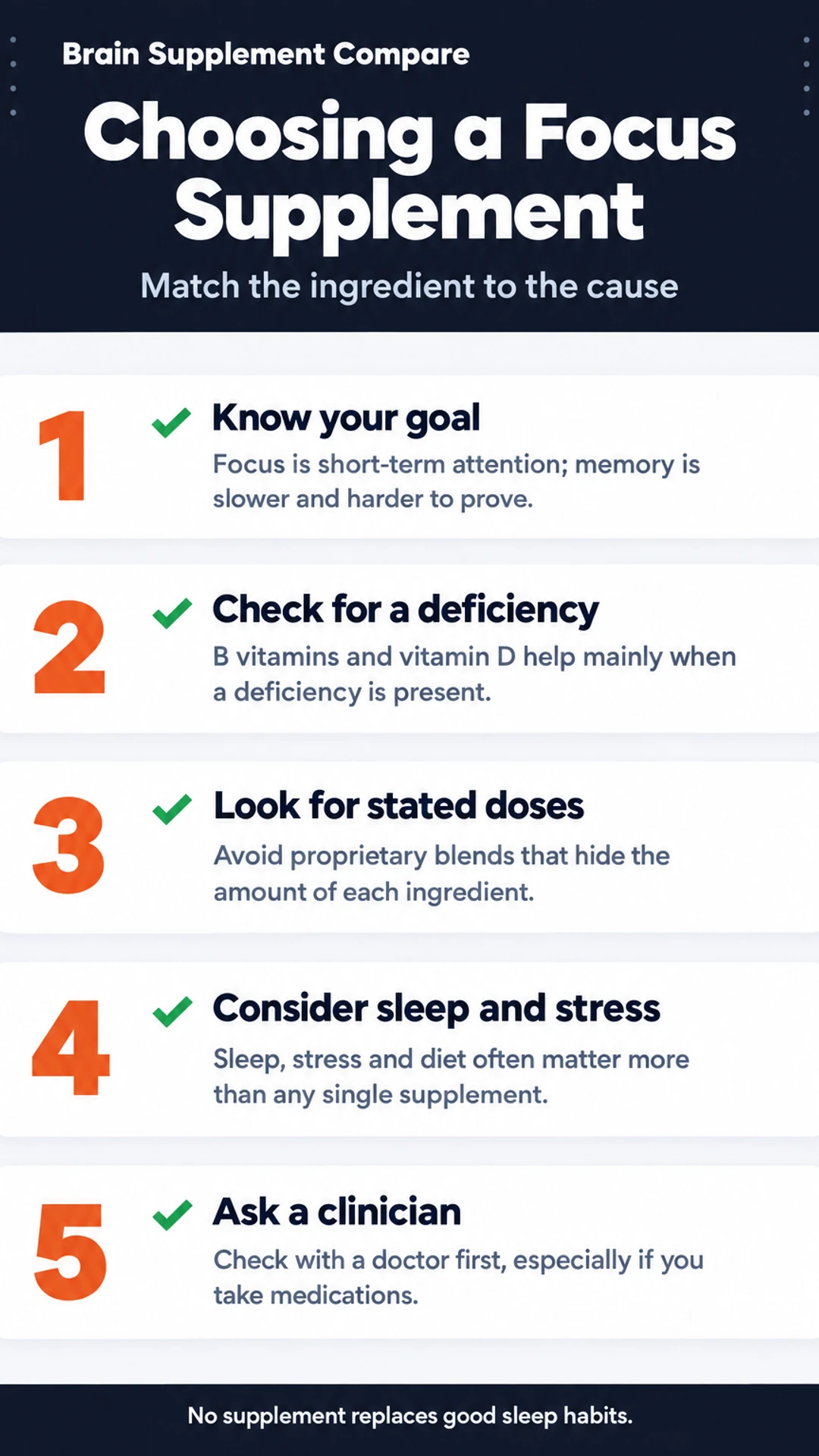
The best focus and concentration supplements are those whose ingredients match the reason your focus is poor. Caffeine with L-theanine supports short-term alertness, B vitamins and vitamin D help when a deficiency is present, and omega-3s and magnesium have a mixed evidence base. Check disclosed doses, avoid proprietary blends that hide amounts, and note that sleep, stress and diet often matter more.
Some links on this site are affiliate links: if you buy through one, the site may earn a commission at no extra cost to you. More about this.
Based on the product's documentation and what users report, not our own testing. Last checked: 14 November 2026.
Focus and memory are not the same problem, and the best supplement for one is often a poor choice for the other. For focus and concentration, the question is whether an ingredient measurably improves attention, alertness or sustained task performance over the short term. For memory, the question is slower and harder to prove. Keep that distinction in mind as you read, because most of the products on this list were built for one or the other, not both.
The best focus and concentration supplements are those whose ingredients match the reason your focus is poor. Caffeine with L-theanine supports short-term alertness, B vitamins and vitamin D help when a deficiency is present, and omega-3s and magnesium have a mixed evidence base. Check disclosed doses, avoid proprietary blends that hide amounts, and note that sleep, stress and diet often matter more.
12 supplements are compared here, chosen by how clearly each one's ingredients are disclosed, how the evidence for focus-related outcomes is documented, and how directly each product's claims can be checked against its label. Phytomem One is included because it is marketed heavily on cognitive claims, and it is one of the few options here where the sales page makes focus-specific promises. Based on the product's documentation and what users report, not our own testing.
The vendor says Phytomem One is a 10-in-1 formula built for lasting mental clarity, recall and resilience. Those are the vendor's claims, not tested results, and the sections below separate what the label shows from what is only asserted.
Let's dive in.
Focus supplements at a glance
| Option | Best for | Key feature |
|---|---|---|
| Caffeine With L-Theanine | Short-term alertness | Dosage not stated in the fact sheet |
| B Vitamins | Correcting a deficiency | Helps mainly where deficient |
| Vitamin D | Correcting a deficiency | Dosage not stated in the fact sheet |
| Omega-3 Fatty Acids | General brain health | Dosage not stated in the fact sheet |
| Magnesium | Sleep and relaxation | Dosage not stated in the fact sheet |
| Rhodiola Rosea | Stress-related tiredness | Dosage not stated in the fact sheet |
| Ashwagandha | Lower perceived stress | Dosage not stated in the fact sheet |
| Bacopa Monnieri | Memory and attention | Dosage not stated in the fact sheet |
A closer look at each
Caffeine With L-Theanine: The most studied short-term alertness pairing and a sensible baseline for comparing the rest. Caffeine is a fast-acting stimulant, while the L-theanine it is often paired with is widely described as easing jitteriness. Most adults use this as a support for mental performance rather than a long-term cognitive function fix.
B Vitamins: Sold heavily for focus and memory, but the real benefit shows up mainly where a deficiency exists.低 B12 or folate status, which is common in older adults and people on certain medications, is the situation where correcting it can help energy, mental sharpness and memory. In someone with adequate intake, a B complex is unlikely to sharpen concentration beyond baseline, so a blood test is the sensible first step.
Vitamin D: A common deficiency whose correction can affect how a person feels overall, including energy and concentration. Low levels are common in people with limited sun exposure, and the right maintenance intake depends on individual needs, so check with a doctor before choosing a dose. The focus benefit is indirect: people who were deficient often report feeling more energetic, but this is not a direct cognitive boost in people who are already replete.
Omega-3 Fatty Acids: Frequently recommended for brain health, with evidence that is mixed for focus specifically. Most products deliver EPA and DHA from fish or algal oil, and the right daily amount varies by product and person, so check the label and a healthcare professional. The stronger research signal is for general brain health and mood than for acute concentration, so expect little difference in short-term focus for someone who already eats fish regularly.
Magnesium: Linked to relaxation and sleep, which indirectly supports concentration for many people. Magnesium glycinate and citrate are the forms most often chosen for sleep and relaxation, though the right amount varies by person. Its value for focus comes mostly through better sleep quality and reduced tension, rather than through any direct stimulating action on attention, so benefits are most noticeable in people who were sleeping poorly to begin with.
Rhodiola Rosea: An adaptogen marketed for fatigue and mental performance under stress. Standardized extracts are used for stress-related tiredness, and some small trials have reported improvements in fatigue and mental effort during stressful tasks. The evidence base is limited and the studies are small, so it is best treated as a possible support for stress-related tiredness rather than a reliable focus enhancer, and people taking antidepressants or other medications should check with a doctor first.
Ashwagandha: Ashwagandha is mostly bought for stress, and it is sold for focus largely because lower perceived stress can make concentration easier. Root extracts of ashwagandha are used in research, often standardized to withanolides, and the right dose varies by product. The research on stress and sleep is more consistent than the research on attention, so a buyer should expect a calmer mind rather than a direct cognitive boost.
Bacopa Monnieri: Bacopa is a traditional herb with a reasonable body of research on memory and attention, though most trials are short, often running 8 to 12 weeks, and many are small. Standardized extracts are used in research, and the right dose varies by product. Effects on recall tend to be modest and slow to appear, so it suits someone willing to wait several weeks before judging it.
Ginkgo Biloba: Ginkgo has been marketed for memory and circulation for decades, but the evidence for focus in healthy adults is weak. Trials of standardized Bacopa extract have not shown consistent gains in attention for people without cognitive decline. It can also interact with blood thinners, so anyone on anticoagulants should check with a doctor first.
Creatine: Creatine is best known for muscle, but it has been studied for cognitive effects, mainly when people are sleep deprived or under stress. Those studies show the most benefit on memory and reasoning in these conditions, not in rested adults. Common supplement doses are 3 to 5 g a day, and the cognitive gains are not well established in people who are well rested.
Vitamin E and Other Antioxidants: Vitamin E and other antioxidants appear in many brain products, but high doses are not always better. Large-dose vitamin E has been linked in some trials to bleeding risk and no clear cognitive benefit, so more is not safer. Stick to amounts near the daily reference intake unless a clinician has advised otherwise, and check the label for total intake from all sources.
Phytomem One: The vendor says Phytomem One is a 10-ingredient formula for focus, recall and resilience, with a dose of one capsule daily with food. The sales page lists saffron extract, berberine HCl, Ceylon cinnamon and Morosil among its ingredients, but does not disclose the amount of each. The product has a 60-day money back guarantee, and refunds are handled by emailing the team. One reviewer found the once-daily routine simple, and another noted that ingredient amounts are not disclosed.
Frequently asked questions
Does Prevagen or Neuriva actually work?
Both are sold as brain supplements, but the evidence for memory and focus benefits is mixed and often thin. Prevagen has been the subject of regulatory action over its memory claims, and the research behind Neuriva's ingredients varies in quality and size. Check the specific ingredient study rather than the marketing, and talk to a clinician if memory problems are new or worsening.
What does Mayo Clinic recommend for memory?
Mayo Clinic's general guidance is that no supplement has been shown to prevent memory loss or dementia. It emphasizes regular physical activity, good sleep, managing blood pressure, diabetes and hearing loss, staying socially engaged, and getting a medical check when memory changes. If you are considering a supplement, Mayo Clinic suggests discussing it with your doctor first.
Can vitamins reduce dementia risk?
No vitamin has been established to reduce dementia risk. Claims like this usually trace back to a single observational study, a subgroup analysis, or a misreported result. Associations between vitamin levels and cognition exist, but they do not show cause and effect, and trials of vitamin supplements in people without deficiency have generally not shown protection against dementia.
What does Joe Rogan take for memory?
Joe Rogan has talked about a range of supplements and about using them on his podcast, but I do not have a verified, current list of what he takes specifically for memory. Podcast mentions change over time and are often offhand. Treat any celebrity stack as a starting point for questions, not a recommendation, and check each ingredient's evidence and interactions yourself.
Is Phytomem One a focus supplement or a memory supplement?
The product's sales page presents it as built for lasting mental clarity, recall, and resilience, so it sits between the two categories. Focus supplements are usually judged on attention and alertness, often in the short term, while memory supplements are judged on recall and learning over weeks or months.
Wrapping up
This roundup covers 12 options for focus and concentration, each judged on its ingredients and what the evidence supports.
No single supplement suits everyone, and the right choice depends on what you need and what you already take.
Which of the 12 will you try first, or which one did we miss?
If Phytomem One fits your goals, you can Visit the official site to read the full ingredient list and current plan details before you decide.