Best Supplement For Memory12 Brain Supplement Questions a Testing Review Can and Cannot Answer
12 Brain Supplement Questions a Testing Review Can and Cannot Answer
The short answer
Independent testing of brain supplements, such as the reviews Consumer Reports publishes, usually checks whether the label matches the contents and whether contaminants like heavy metals are present. It does not measure whether a product improves memory or focus. Cognitive benefit needs controlled clinical trials, and many common brain-supplement ingredients have mixed or limited evidence. Read a testing report for what it verified, and treat efficacy claims as separate.
Some links on this site are affiliate links: if you buy through one, the site may earn a commission at no extra cost to you. More about this.
Based on the product's documentation and what users report, not our own testing. Last checked: 14 November 2026.
If you are comparing brain supplements, the useful question is which claims a given source can actually support. This page covers what a testing review can and cannot tell you, using 12 questions that buyers and older readers tend to ask. The questions were chosen from the points where label accuracy, contaminant screening and cognitive evidence are most often confused.
Each answer is kept to what a testing report can verify and what it leaves open. Where a claim goes beyond testing, we say so and point to the kind of evidence that would be needed.
We also look at one product, Phytomem One, as a worked example. Based on the product's documentation and what users report, not our own testing. Its sales page makes efficacy claims, and the questions below show how to separate what is verified from what is only asserted.
Let's dive in.
Brain supplement review questions at a glance
| Option | What it is | Key evidence or concern | Who it's relevant for |
|---|---|---|---|
| Independent testing review | Label accuracy and contaminant checks | Verifies contents, not cognitive benefit | Buyers checking label honesty |
| Omega-3 fatty acids | EPA and DHA from fish or algae | Mixed trial evidence on cognition | People with low dietary intake |
| B vitamins | Folate, B12, B6 | Helps true deficiency, weak otherwise | People with confirmed deficiency |
| Vitamin D, magnesium, vitamin E | Common brain formula additions | Vitamin E linked to bleeding risk | Those not deficient, anticoagulant users |
| Lion's mane and ginkgo biloba | Herbal brain formula ingredients | Thin or mixed evidence | Readers weighing herbal inclusions |
| Phytomem One | Ten-ingredient multi-ingredient product | Efficacy claims unverified, blend undisclosed | Worked example in the article |
A closer look at each
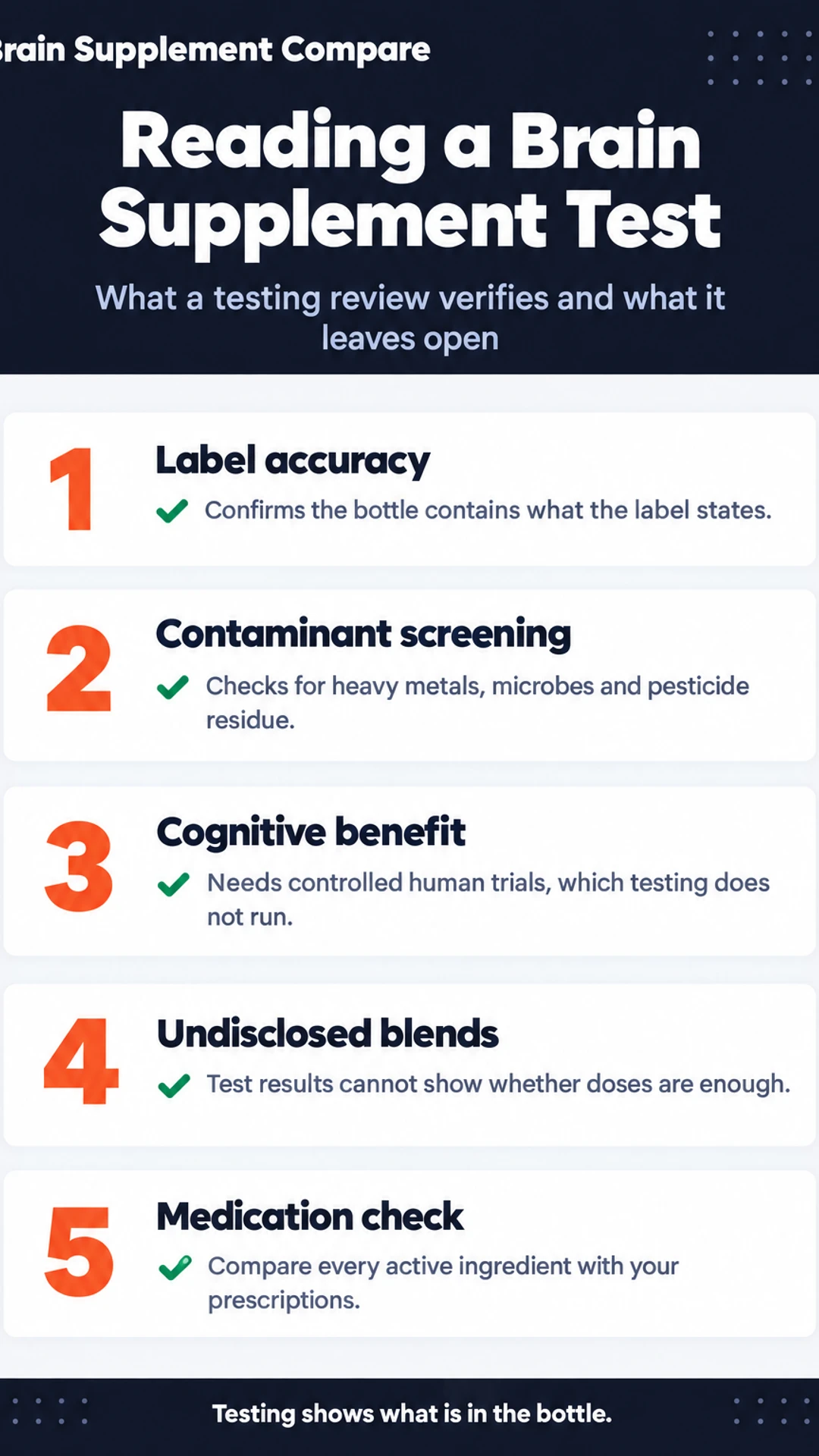
What label accuracy testing checks: Independent testing first confirms that the bottle contains what the label says, in roughly the amounts stated. Buyers often assume this covers everything, but it does not. A label can be accurate and still list an ingredient at a dose nobody has tested for memory. Label accuracy tells you the bottle is honest, not that it works for your brain, your blood pressure, or your sleep.
What contaminant testing covers: This is the safety side of a review and usually the most useful part for most buyers. Testers look for heavy metals such as lead and arsenic, microbial contamination, and sometimes pesticide residue, and check that the product dissolves and releases its ingredients. A clean result means the product is unlikely to carry those specific hazards. It does not mean every supplement in the category is safe for everyone, especially if you take blood thinners or medicine for blood pressure or diabetes.
What testing cannot show about cognitive benefit: This is the core gap. Most people searching for a brain supplement want to know whether their memory or focus will improve, and product testing does not measure that. A lab can confirm a capsule contains 100 mg of an ingredient but cannot tell you whether that dose changes recall in people over 60 after twelve weeks. Cognitive benefit needs controlled human trials, and a contents-and-contaminants review does not run them.
Omega-3 fatty acids: Omega-3s, usually EPA and DHA from fish or algae oil, are among the most studied ingredients in brain supplement lists, and the evidence is genuinely mixed. Some trials suggest small benefits for people with low dietary intake, while larger trials in healthy older adults have often found little effect on memory or dementia risk. A testing review can confirm the EPA and DHA amounts and check for oxidation, but whether those amounts help your cognition is a separate question.
B vitamins: Folate, B12 and B6 matter for brain function, and a true deficiency can cause real cognitive symptoms that improve with replacement. That is different from boosting function in someone whose levels are already normal, where the evidence is much weaker. Testing confirms the vitamin content of a B-complex, but it cannot tell you whether you are deficient. A simple blood test from your doctor answers that question far better than any label.
Vitamin D, magnesium and vitamin E: These appear on many brain supplement lists and are worth a separate look. Vitamin D and magnesium have associations with cognition, but in people who are not deficient, supplementation has not clearly improved memory in trials. Vitamin E at high doses has been linked to bleeding risk, which matters if you take anticoagulants. Testing will confirm the amounts on the label, and it is the dose and your existing medicines that decide whether these are a sensible addition.
Lion's mane and ginkgo biloba: Both herbs turn up in many brain formulas, but the evidence is thin and mixed. Lion's mane has small, short trials, mostly in people with mild cognitive impairment, and most used doses far above what a single capsule supplies. Ginkgo's large trials, including the GEM study of older adults, did not show it prevented dementia. Check the dose per serving before weighing either herb's inclusion.
Proprietary blends and undisclosed doses: This is the biggest limit on any test of a multi-ingredient product. A blend lists total weight without per-ingredient amounts, so you cannot judge whether a dose matches what studies used. Phytomem One's sales page lists ten ingredients, including berberine HCl and banaba leaf, but reviewers note ingredient amounts are not disclosed. A test can confirm what is present, not whether it is enough.
Safety checks before you buy: Before starting, read the label for every active ingredient and compare it against your prescriptions and over-the-counter drugs. Berberine can affect how the liver processes several common medications, and banaba leaf is studied for blood sugar lowering, so people on diabetes drugs need a clinician's input. Ginkgo can increase bleeding risk alongside blood thinners. Check with a doctor if you have concerns about safety before you start taking it. The product's page advises this, and it is offered only to users who are 18 or older.
Brain fog: causes that supplements do not address: Brain fog is a symptom, and its causes are often medical or lifestyle. Thyroid disease, anemia, low vitamin B12, poor sleep, sleep apnea, depression, medication side effects and blood sugar swings all produce it. A supplement cannot diagnose these. If fog is new, persistent or worsening, a blood panel and a medication review are the right first steps, not a bottle.
How to read a testing report: Start with the test scope, which says what was measured, such as label accuracy, contaminants like heavy metals, or microbial counts. Then check the sample: how many lots, bought where, and when. Look for the dose-versus-label comparison and any failed results. Finally, note what is absent: a report that tests purity says nothing about whether the product improves memory or recall.
Matching a label to a testing report: Take the exact product name, lot number and expiration date from your bottle. Confirm the lot appears in the report, or that the report covers that formulation and batch range. Compare each listed ingredient and its amount with the test results. Check the test date against the bottle's age. If the lot is not listed or the amounts are unlisted, the report cannot verify that bottle.
Frequently asked questions
Is there an effective brain supplement?
No supplement has strong, consistent evidence that it improves memory or thinking in healthy adults. Some ingredients, such as omega-3 fatty acids in people with low intake, show modest effects in certain studies. Independent testing can confirm a product contains what its label says, but it does not show that the product sharpens the brain.
What do Japanese eat to prevent dementia?
Traditional Japanese diets are built around fish, soy, vegetables, seaweed, green tea, and rice, with relatively little red meat and fried food. Observational studies have linked this pattern with lower dementia rates, but these studies cannot prove cause. Lifestyle factors such as daily walking and social contact are also part of the picture.
Does sugar cause brain fog?
Large blood sugar swings can leave people feeling foggy, tired, or unable to concentrate, particularly after a heavy refined-carbohydrate meal. Most people, though, do not have a clinical problem with sugar itself. If brain fog is persistent, it is worth looking at sleep, medications, thyroid function, and blood sugar control with a clinician.
What does Mayo Clinic recommend for memory?
Mayo Clinic's guidance centers on habits rather than pills: regular physical activity, a heart-healthy diet, good sleep, managing blood pressure and blood sugar, staying socially and mentally active, and not smoking. It also advises talking with a doctor about memory changes, since some causes such as thyroid problems, vitamin deficiencies, and medication side effects are treatable.
Do brain supplements work for memory?
Evidence for most brain supplements is limited or mixed, and results from small trials often do not hold up in larger ones. Supplements are not regulated like drugs before sale, so the label is the manufacturer's claim. Testing for purity and contaminants is a separate question from whether a product improves memory.
Wrapping up
That covers 12 questions a testing review can and cannot answer, and the gap between product quality and cognitive benefit is the one most buyers miss.
Which of these 12 will you check first, or is there one we missed? Tell us in the comments and we will look into it.
If you are considering Phytomem One, according to the sales page it is a 10-in-1 formula built for mental clarity, recall, and resilience, sold only on its official site. Based on the product's documentation and what users report, not our own testing, you can review the ingredient list and plan options directly on the Visit the official site page before deciding.